
Three Legs Carrying Four Legs of Work
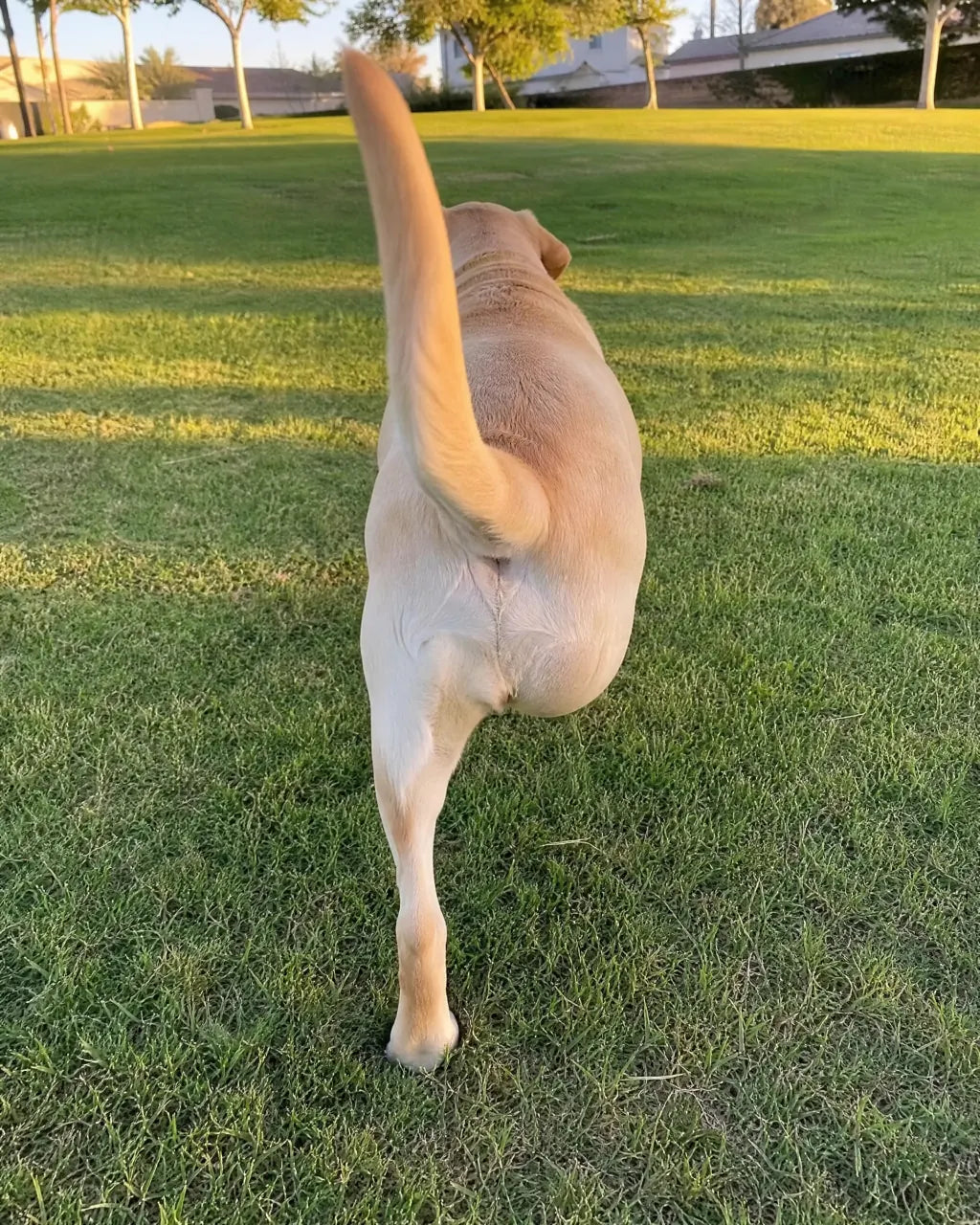
He hops. He digs. He runs. One front leg does all of it.
That is what every tripawd owner notices around month four post-amputation. The dog is fine. The remaining joints are doing more.
Why the front load shifts
A four-legged dog distributes ~60% of body weight on the front. A front-leg amputee tripawd? That same 60% rides the one remaining shoulder, and 60% of the rear weight migrates to the opposite hip.
The cascade owners report:
- Year 1-2: he runs. He digs. He looks fine.
- Year 3+: the shoulder dip starts. The opposite hip starts working harder.
- Year 5+: the stairs become a question. The couch hop becomes a calculation.
Surfaces that help vs. surfaces that hurt
Help: rugs, runners, grass, packed dirt, carpeted stairs.
Hurt: hardwood, vinyl, polished concrete, bathtubs.
The kitchen-floor slip is the one tripawd owners regret not fixing earlier. Toe Grips help. So does a runner.
Weight management without cutting fun
Lean is not optional. Three legs carrying an extra 5 lbs is the difference between "fine at year 5" and "stopping stairs at year 5."
The daily chew sits inside the calorie budget. Two chews a day is ~6 kcal. Bonus: it earns the routine.
The supplement stack tripawd owners actually use
From r/tripawds owner threads:
- Glucosamine + chondroitin (everyone)
- MSM (most)
- Hyaluronic acid (the ones who did the homework)
- Green Lipped Mussel (the rare ones who did the homework - and the data backs it)
- Fish oil (separate)
- Adequan (vet-prescribed, not a chew)
TROT covers the first 4 in one chew, plus green lipped mussel, hemp seed oil, and vitamin C. One chew, seven actives. Two minutes a morning.
Walk pattern: short and frequent
Three 15-minute walks beat one 45-minute loop. Joint compression scales with reps; fatigue scales with single-walk length. Spread the load.
What we use: TROT, daily joint chew. Built for the dog whose remaining joints carry more. See the formula →